Monday, January 4, 2016

Worcester Carpenters Raise Red Flag on Court House Developer

Monday, January 04, 2016
GoLocalWorcester News Team and Kate aNgle

A developer who works throughout New England is under fire in New Hampshire — and workers unions and environmentalists are now asking the EPA to investigate all Brady Sullivan properties throughout the region, including Worcester.

Developer Brady Sullivan is currently the subject of a lead contamination lawsuit at Mill West in Manchester, NH, and Kevin Ksen with the Carpenters Local #107 in Worcester said a petition to the EPA with over 20,000 signatures is intended to monitor all of the developer’s properties, and cited examples of labor issues in Massachusetts that prompted the action. 

“We had some experiences with labor issues at Brady Sullivan properties in Massachusetts,” said Ksen.  “Our main concern is when property is developed, are they hiring quality workers, and doing legitimate work.  What happened in [New Hampshire], another contractor wouldn’t get away with that. So when that lawsuit moved forward, that’s what moved us to do the petition with Clean Water Action and Public Citizen,” said Ksen.  

“We're saying here's some more information now, and we think that an investigation needs to happen at all the properties. They're getting taxpayer money to do all this, and they're getting a lot,” said Ksen. “We’re paying them to do this. Lancaster Mills in Clinton, Pacific Mills in Lawrence, New Home Sewing in Orange, and both the Junction Shops and Worcester County Courthouse are all getting historic tax credits.”

Brady Sullivan did not respond to request for comment on the EPA petition, or labor issues cited by the carpenters.

Labor Issues at Core
Ksen, along with David Minasian, organizer for the New England Regional Council of Carpenters, spoke about the labor issues with Brady Sullivan in Massachusetts. 

Ksen cited the finding by the Commonwealth’s “Joint Enforcement Task Force on the Underground Economy and Employee Misclassification” that ruled in November 2014 that contractors were misclassified at Brady Sullivan’s Junction Mill Shops in Worceseter, with stop work orders being issued, and an administrative violation filed for the corporate office having the the wrong address on file. 

“In Clinton [at Lancaster Mills], the contractor who works for Brady Sullivan — Interior Partition Systems — hadn’t paid a number of employees, so [the workers] came to us, and the Connecticut Department of Labor had to step in, since that’s where the contractor’s from,” said Minasian.  “In a matter of days, the works were paid, but they still had to come to us.” 

“[Brady Suliivan] is not just the own developer, they oversee the contractors and they do the hiring. They have a direct responsibility,” said Minasian.  “So what we’re seeing is  they’re blaming someone else, and that’s a  little harder to do in this case."

“The carpenters union, we just want to ensure that the standards are there, and the workers are safe, they're paid, and they go home with money in their pocket and all their fingers and toes,” said Minasian. “Immigrant, non-immigrant, union or non-union.  Unfortunately our enforcement agencies don't always to their jobs.“

As GoLocal reported in April when the of City of Worcester reached an agreement to sell the former Worcester County Courthouse for $1.2 million to  Brady Sullivan Properties, LLC.

The City Council voted unanimously to approve the sale of the Courthouse to Brady Sullivan. Brady Sullivan has proposed 115 high class residential apartments and a 3,000 square foot retail space to occupy the old Courthouse.

The deal, which was announced by City Manager Ed Augustus on March 19, was being held up by labor unions because the unions.  As part of its deal with the city, Brady Sullivan did agree to try to hire 50 percent of its workers from local construction labor force.

"This is a very important project for downtown Worcester and the north end of Main Street," said Joe Petty at the time of the vote in April. "It's important that we ensure that people in this community reap some of the benefits."

Unions Have Trouble Trusting Brady Sullivan

Leo Miller, Business Manager of Local 96 International Brotherhood of Electrical Workers and Vice President of the Worcester-Fitchburg Building Trades Council, spoke at the Council meeting in April. Miller said, "We want to call upon the construction component of this economic development initiative and the concerns that we have for the current and past failures of Brady Sullivan to responsibly parent the construction piece which plays such a critical role in ensuring safe, code compliant homes."


Petition Wants Broader Look

The petition, which garnered over 20,000 signatures, is urging the EPA and state environmental regulators to “undertake a full audit of Brady Sullivan’s many converted mill properties in New Hampshire, Massachusetts and Rhode Island and levy appropriate fines against Brady Sullivan to hold it accountable and to ensure that no more of its residents or workers are exposed to dangerous levels of lead.”

“In Manchester and across New England, behind Brady Sullivan’s multimillion-dollar taxpayer-funded projects are a lot of problems for the underpaid workers who build them and the taxpayers who pay for them. And now, sadly, the tenants at Mill West are exposed to the biggest known lead hazard in recent New England history,” said Minasian. “The lead dust incident at Mill West is not surprising as Brady Sullivan’s business model is based on maximizing profits by hiring low-road contractors that cut corners to increase profits. Unfortunately this approach has endangered workers and now has put their tenants at risk.”

Ksen that “crossing state lines” in bringing the issue to light is “difficult, but necessary.” 


“It’s newer for us to deal with someone crossing state lines.  As a union we're not necessarily prepared to deal with this. States don't have the overarching enforcement , with different Attorney Generals,” said Ksen.  “But we thought that folks should be aware anywhere Brady Sullivan is of what is going on.”

Minimum wage rises in 14 states and several cities

With federal minimum wage flat for more than six years, states and cities are moving forward with their own increases

January 3, 2016 12:30PM ET

As the United States marks more than six years without an increase in the federal minimum wage of $7.25 an hour, 14 states and several cities are moving forward with their own increases, with most having taken effect Jan. 1.

California and Massachusetts are highest among the states, both increasing from $9 to $10 an hour, according to an analysis by the National Conference of State Legislatures. At the low end is Arkansas, where the minimum wage is increasing from $7.50 to $8. The smallest increase, a nickel, comes in South Dakota, where the hourly minimum is now $8.55.

The increases come in the wake of a series of "living wage" protests across the country, including a November campaign in which thousands of protesters in 270 cities marched in support of a $15-an-hour minimum wage and union rights for fast food workers. Food service workers make up the largest group of minimum-wage earners, according to the Bureau of Labor Statistics.

With Friday's increases, the new average minimum wage across the 14 affected states rises from $8.50 an hour to just over $9. Several cities are going even higher. Seattle is setting a sliding hourly minimum between $10.50 and $13 on Jan. 1, and Los Angeles and San Francisco are enacting similar increases in July, en route to $15 an hour phased in over six years.

Backers say a higher minimum wage helps combat poverty, but opponents worry about the potential impact on employment and company profits.

In 2014, a Democratic-backed congressional proposal to increase the federal minimum wage for the first time since 2009 to $10.10 stalled, as have subsequent efforts by President Obama. More recent proposals by some lawmakers call for a federal minimum wage of up to $15 an hour.

Alan Krueger, an economics professor at Princeton University and former chairman of Obama's Council of Economic Advisers, said a federal minimum wage of up to $12 an hour, phased in over five years or so, "would not have a noticeable effect on employment."

Some employers may cut jobs in response to a minimum-wage increase, Krueger said, while others may find hikes allow them to fill job vacancies and reduce turnover, lifting employment but lowering profits.

The nonpartisan Congressional Budget Office estimated the 2014 federal proposal would have raised the wages of 16.5 million Americans and lifted 900,000 of them out of poverty but would have cost as many as 1 million jobs.

Currently, 29 states plus the District of Columbia and about two dozen cities and counties have their minimum wage at levels higher than the federal minimum. Many are now in the midst of multiyear phase-in plans that will ultimately take them to between $10 and $15 an hour.

The 14 states where increases took effect Jan. 1 are: Alaska, Arkansas, California, Colorado, Connecticut, Hawaii, Massachusetts, Michigan, Nebraska, New York, Rhode Island, South Dakota, Vermont and West Virginia.


Reuters

Sunday, January 3, 2016

Is shrinking the middle class a good thing?

Why some conservatives reject concerns about economic inequality


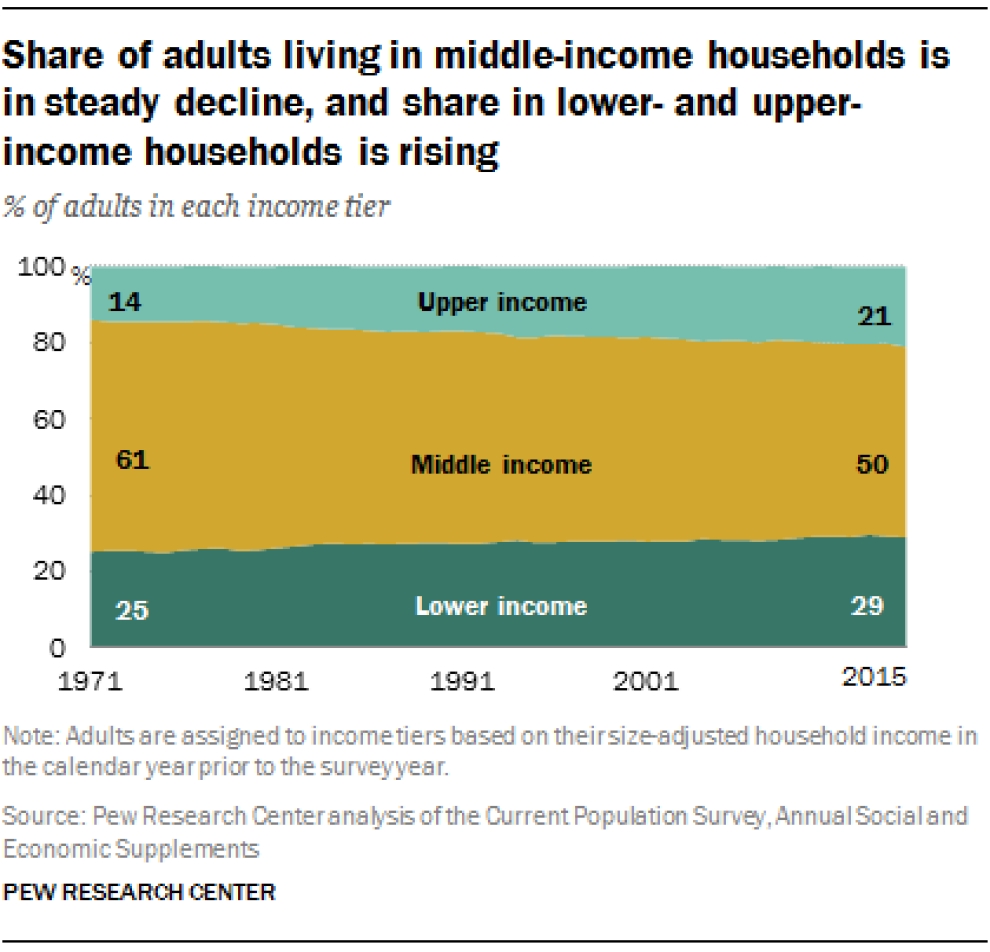
A recent report from Pew Research, “The American Middle Class Is Losing Ground,” isn’t exactly conducive to holiday cheer for most of us. Middle-income households, defined as those earning $42,000 to $126,000 a year, are capturing a smaller share of the American pie; the middle class, after enjoying a great run as the country’s majority economic group for four decades, appears to have sputtered. In terms of income share, this group is now matched in size by the economic tiers above and below it.


But to many laissez-faire conservatives, this news is far from gloomy. Writer-provocateur and Adam Smith Institute fellow Tim Worstall, writing at Forbes, complains (after warning that people often read statistics to justify their political biases) that the report will send folks “bleating away about the death of the American middle class” and collapsing into “shrieks of egalitarian horror” when we should be cheering. He argues that the “bleaters” have got it wrong. The real story is not that the middle class is shrinking but that the upper middle class is expanding and, most important, the ranks of the poor are decreasing.

In Worstall’s mind, the poor appear to be “movin’ on up,” just like George Jefferson of sitcom fame, catapulting into higher echelons to join the rich. Hooray for unbridled capitalism! How could everyone have gotten the story wrong?

Actually, Worstall gets it almost all wrong. He admits, in a note appended to his column, that he misread the Pew chart, which shows quite clearly that the ranks of the poor are, in fact, growing rather than shrinking. The theme song of this chart not “Movin’ On Up” but “Slip-Slidin’ Away.”

The Pew numbers indicate that in 1971, 16 percent of Americans were in the lowest income tier and 9 percent were in the second-lowest tier (the two groups below the middle class). That’s 25 percent of us, or 1 in 4, living below the middle-income level. Fast-forward to 2015: Now we’ve got 20 percent in the lowest tier and 9 percent in the second lowest, for a total of 29 percent below the middle class. A bigger percentage of us is badly off.


The Pew report further states that the middle-income tier shrank during this period, from 61 percent of Americans in 1971 to 50 percent in 2015. Worstall grumpily acknowledges that he screwed up in claiming that “we’ve got fewer poor people” today and explains that he suffered from “brain spasms that had me reading the left hand side of the chart chronologically downwards and the right hand side upwards.”
Yet even after realizing his mistake, he asserts, quite unembarrassed, that the substance of his argument that the shrinking middle class is not a problem holds true. Why? Because, he says, more people have gotten richer than have gotten poorer, so even if the middle class is proportionally shrinking, things are still looking good.

It is a near-religious belief among free market fundamentalists that having more rich people is good for society; it’s the essence of trickle-down economics. Many insist that inequality itself is good for society because it drives people to succeed and, besides, the market should decide who makes it. Former Sen. Rick Santorum notably made this claim in 2012, saying, “There is income inequality in America. There always has been, and hopefully — and I do say that — there always will be.” 

There may be a few more people joining the ranks of the rich, but the real news is that those who are already rich are getting much, much richer.

To abandon such notions is to admit that policy choices in the last few decades have been detrimental to the American way of life, if by that you mean increased opportunity and mobility for the many rather than the few. Thus the brain spasms working their way through the conservative punditry in the wake of the Pew report: Over at The National Review, Scott Winship argues that too many analysts are “hung up on inequality,” that a “modest increase in polarization” of incomes is nothing to worry about and that, anyway, the Pew definition of middle income is arbitrary. He also trots out the familiar claim that the poor are better off than they used to be, a view shared by Rep. Darrell Issa, the wealthiest member of Congress, who has cited such amenities as coffeemakers and cable TV accessible to America’s poor, as opposed to those living in the developing world. No doubt Ebenezer Scrooge would agree.


Free market champions reading the Pew chart see percentages rise more sharply in the very richest category and jump to the conclusion that the chances of becoming rich are increasing. But the reason for that sharp rise is that there are fewer rich people than poor people in absolute numbers. There are about 46 million Americans living below the poverty line. In contrast, there are some 10 million folks in the U.S. living in millionaire households. 

According to Pew, there are 120.8 million adults living in middle-income households, compared with 121.3 million who are in upper- or lower-income households; 9 percent are in the highest quintile, and 20 percent are in the lowest. It’s clear from the Pew report that the people who have the biggest incomes have been pulling away from the pack in terms of their share of wealth — a trend that shows no sign of slowing.

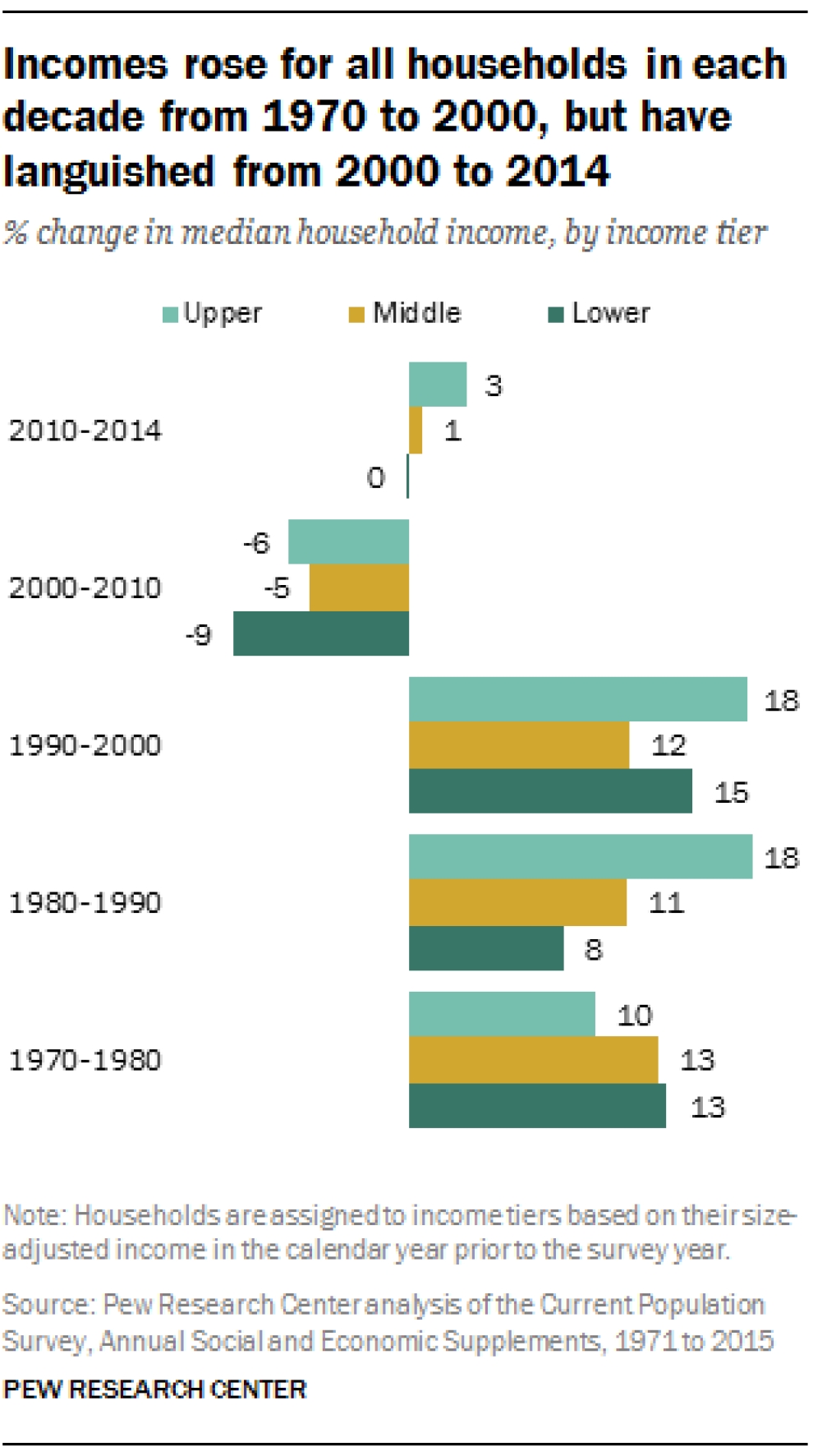
“The share of U.S. aggregate household income held by upper-income households climbed sharply, from 29 percent in 1970 to 49 percent in 2014,” Pew states. “More recently, upper-income families, which had three times as much wealth as middle-income families in 1983, more than doubled the wealth gap; by 2013, they had seven times as much wealth as middle-income families.”


There may be a few more people joining the ranks of the rich, but the real news is that those who are already rich are getting much, much richer.

Worstall is right about one thing: Our political biases influence the story we attach to numbers. The laissez-faire defenders want so badly to erase the problem of inequality and reduced prosperity for the bulk of Americans that their brains fail to read simple charts and employ elementary logic.


They do not want to believe that more Americans are becoming worse off, because this development flies in the face of the big free market promises made by Milton Friedman and his followers — that unfettered capitalism will deliver the best outcomes to society. But if you take off the ideological blinders, it’s easy to read the plain numbers on the wall. A giant chunk of Americans is sinking economically, and we need to focus on policies that aid the drowning and make room for ordinary people among all the mega-yachts.

Omaha Police Union Local 101 v. City of Omaha

 Omaha Police UnionLocal 101, IUPA, AFL-CIO, also known as Omaha Police Officers Association, appellee and cross-appellant, v. City ofOmaha, a municipal corporation, appellant and cross-appellee. 
___ N.W.2d ___ 
Filed December 31, 2015. No. S-14-1153. 


NATURE OF CASE
The appellee and cross-appellant, the Omaha Police Union Local 101, IUPA, AFL-CIO, also known as the Omaha Police Officers Association (Union), filed a declaratory judgment action against the appellant and cross-appellee, City of Omaha (City). The Union requested the district court declare that the collective bargaining agreement between the Union and the City had rolled over to the 2014 calendar year. The Union claimed that the City did not timely provide written notice of its intent to negotiate or modify the terms of the contract for 2014. The City argued that the Union’s action was barred by the doctrines of waiver and equitable estoppel. It claimed written notice was waived by the Union or the Union was estopped from asserting that the City was required to give written notice of its intent to negotiate changes to the contract. We affirm the order of the district court granting declaratory judgment to the Union and denying its request for attorney fees.

FACTS
The parties entered into an agreement which was to remain in effect from December 14, 2008, until December 21, 2013 (Contract). The Contract contained an “evergreen clause” (Article 47), which provided for an automatic extension of the Contract if neither party notified the other of a desire to modify or renegotiate any portion thereof. Article 47 provided:
This Agreement shall be and shall remain in full force and effect from and after . . . December 14, 2008, until . . . December 21, 2013, and thereafter for successive one (1) calendar year periods, unless one of the parties hereto on or before April 1st of any such year shall notify the other party hereto in writing of its desire to modify the same, or any part thereof.

Neither party disputes that Article 47 required written notice of intent to negotiate changes by April 1, 2014, and that notice was not provided by either party by that date. Consequently, whether the district court erred in granting declaratory relief depends upon whether it erred in rejecting the City’s equitable defenses.
- 384 -
Nebraska Advance Sheets
292 Nebraska Reports
OMAHA POLICE UNION LOCAL 101 v. CITY OF OMAHA
Cite as 292 Neb. 381
OMAHA POLICE UNION LOCAL 101 v. CITY OF OMAHA
Cite as 292 Neb. 381

Attorney Fees
Finally, we conclude that the district court did not abuse its discretion in ordering the parties to pay their own attorney fees. The City failed to meet its burden of showing its equitable defenses. But the City’s interpretation of the Union’s conduct was not so wholly without merit as to be frivolous or in bad faith.

CONCLUSION
For the reasons stated above, we affirm the order of the district court granting declaratory judgment to the Union and ordering the parties to pay their own attorney fees.
Affirmed.

Saturday, January 2, 2016

Chicago's historic property tax increase expected to burden working class

The largest property tax increase in Chicago’s modern history was written into the city’s $7.8 billion budget

January 2, 2016 5:00AM ET


CHICAGO — Helen Alexander tried to make her new apartment building a little nicer when she moved in a year and a half ago.

The 56-year-old grandmother scrubbed the hallways and planted a garden outside the four-unit building in the Belmont Craigin neighborhood on Chicago’s northwest side. She lives in a two-bedroom apartment with her 21-year-old granddaughter and shih tzu. A lifelong resident of Chicago, she can name the address of the house in which she was born.

“It’s scary,” Alexander said. “It’s scary when you not knowing where you’re going to be, where you’re going to go, and if you can stay in your apartment.”

Alexander pays $1,050 per month in rent, but that’s likely to increase. In October, Chicago’s city council passed a historic property tax increase — said to be the largest in the city’s modern history. Chicago landlords are likely to pass that cost onto tenants like Alexander, who is barely getting by as is.

That burden, activists say, is going to displace long term, lower-to-middle income residents in Chicago’s diverse communities, hastening gentrification of the city that has already been called the most segregated in the United States. Overall rent in the city jumped more than seven percent between 2013 and 2014.

Around half of all Chicago’s residents are renters, according to the Chicago Rehab Network. According to real estate website Zillow, Chicagoans put an average 21 percent of their income towards rent between 1985 and 2000. That percentage is now more than 30 percent. According to Census data, more than half of Chicago’s renters are paying more than a third of their incomes in rent — a rate that the federal government defines as unaffordable.

And that was before the new property tax.

“I don’t have no more money to give that landlord,” said Alexander, who lives on a fixed income and pays more than a third of her income on rent. “I’m just one of those scared as hell, just waiting to see what’s going to happen.”

On Oct. 28, Chicago’s city council passed Mayor Rahm Emanuel’s $7.8 billion budget in a 35-15 vote. The budget included a 72 percent property tax increase worth some $550 million, to be fully implemented by 2019, raising the overall tax bill 13 percent. For every $250,000 of a home’s appraised value, property owners will see a $500 increase in annual property taxes.

“It’s now to the point where working families cannot give anymore,” said Diane Limas of Communities United, a grassroots organization in Chicago. “Our backs are bending already, and I’m afraid that this tax increase on working families is the straw that’s going to break the camel’s back.”

For tenants, this means higher rent. Nearly one-third of the city’s rental stock is composed of two-to-four-flat buildings, according to the Institute for Housing Studies at DePaul University. A higher property tax will be spread between fewer tenants in buildings like these. In 2014, Communities United, a grassroots advocacy organization in northwest Chicago, analyzed census data and found that, in some neighborhoods, the property tax increase could translate to a rent hike upwards of $100 per month.

Data for 2015 is not yet complete, but according to rental service Zumper rents were still on the rise even before the property tax increase. Rent for one-bedroom units in Chicago have increased by more than 13 percent this year — though cities like Oakland and Phoenix saw higher increase of 19 and 15.4 percent, respectively.

“I don’t have secure income,” said Veronica Solis, who supports her family by selling corn flour in Chicago’s Albany Park neighborhood, where she’s lived for two decades. “And with the increase of property tax, it’s going to affect me even more.”

Solis pays $1,100 per month in rent, and said her friends and neighbors share her concerns of having their rents hiked to account for the property tax and a $9.50-per-month garbage fee that was also tacked on to the new budget.

“That’s not enough to pay the rent and bills,” Crescencia Delgado, a resident of Albany Park — a diverse neighborhood on Chicago’s northwest side — said of her husband’s minimum wage job. “So how are we going to be able to afford that [property tax increase]?”

Helen Slade, an Albany Park property manager, said she will have to pass the property tax hike onto her tenants. The most conservative estimate she’s been able to come up with is an additional $20 per month.

“That’s a lot for some of our tenants,” She said. “It’s unavoidable. We’ll have to pass it on.”

Proponents of the increase say it is needed to stabilize the troubled finances of the country’s third largest city. The property tax hike will largely go toward backing up Chicago police and firefighter pensions. Earlier this year, Moody’s Investors Service knocked the city’s credit to junk status because of its $20 billion pension deficit.

The city’s public school system is also facing a looming crisis. If state money doesn’t come through, Chicago Public School District officials are warning of possible layoffs amid discussion of school closures, consolidation, and cuts. Chicago Public Schools relies on the state for nearly $500 million.

“It’s one thing to raise our taxes, but our services aren’t getting better,” Limas said. “Our services are getting worse and worse. As working families are paying more and more, the services from our city are getting less and less.”

“All of this affects the children,” Solis said. “Everything goes hand in hand. And they’re the future of this country, and this is the problem.”

Limas and others have informally proposed alternatives to the tax increase, including a so-called “luxury tax” or raising taxes on the city’s wealthiest residents, who they say can afford to pay more.

“There’s ideas on the table,” Chicago Alderman Carlos Ramirez-Rosa said at a Communities United press conference ahead of the city council’s October vote. “Whether it’s a TIF surplus, whether it’s the revenue ordinances the Progressive Caucus brought forth that are now being held in the Finance Committee — there’s more that we could do to mitigate this property tax increase before Oct. 28.”

He added: “Unfortunately, I don’t think that we have a partner in the mayor’s office that’s willing to do that.”

Mayor Rahm Emanuel’s office did not respond to a request for comment.

In a statement released by the Mayor’s office the day the budget was passed, Emanuel commended the city council for moving to stabilize the city’s troubled finances.

Back in Chicago’s northwestern neighborhoods, residents and property owners are trying to plan — or brace — for the next step.

“The diversity and the areas that look like this, they’ll be gone,” Limas said. “To lose that, it would be a catastrophe.”

“I think the desire to make money off real estate is the problem,” Slade said. “I think if we as a society saw housing as a protected right instead of a way to make money, we wouldn’t have this problem.”

Helen Alexander of Belmont Craigin said she’s waiting to hear from her landlord if her rent will go up.

“I’m just hurt, confused, and don’t know what’s going to happen,” she said.


“I just hope somebody will look out for us.”

Friday, January 1, 2016

This year, bright spots for workers came from below

Progress on the minimum wage and labor rights was made at the local level — and it’s starting to bubble up

December 31, 2015 2:00AM ET


Unions continued a fight for their lives in 2015, and will no doubt continue to do so for years to come. The Supreme Court is currently poised to hear a case that could significantly weaken one of the movement’s last remaining strongholds: public sector unions. And there’s little help to be found in Congress: Republican majorities refuse to raise the minimum wage — much less pass pro-worker legislation to allow workers to more easily organize collectively.

Given the gridlock and fierce ideological partisanship that pervades Washington these days, it is not surprising that many of the most positive developments from this year have happened at the local level. Although progress on the local level can sometimes seem small or disjointed, innovations in cities and states are together beginning to shape a national agenda for how to confront inequality, restore the American middle class and refashion the increasingly tattered workplace contract offered by many American employers. From the Fight for $15, to winning campaigns for paid sick leave, to local ordinances banning abusive scheduling on the part of employers, 2015 brought some signs of hope.

2015 was a banner year for the fight for a $15 an hour minimum wage. In May, Los Angeles took the extraordinary step of becoming the largest city in the nation to approve a $15 minimum wage, to be phased in over five years. The vote raised wages for some 800,000 people, and came on the heels of similar decisions in San Francisco and Seattle. Pressure in cities then spread to the state level. In July, New York Governor Andrew Cuomo finally caved to grassroots demands by agreeing to a $15 minimum wage for fast food workers, and in November he extended it to all state employees. Elsewhere in 2015, Rhode Island hiked its minimum wage in June, and in October ballot initiatives for a $15 minimum wage in states across the country were launched. We may wind up looking back at 2015 as the year when the $15 minimum wage went from being an improbable demand to a rapidly spreading reality.

Local activists are also fighting to determine what other baseline standards of employment in the American economy should be. For example, in June, Oregon became the fourth state in the nation to guarantee paid sick leave to people at businesses with 10 or more employees. Then, in August, Pittsburgh passed its own law guaranteeing workers paid time off for illness. It joined Tacoma, Washington; Philadelphia; Bloomfield, New Jersey; and Chicago, as cities that have all established such protections in 2015. Campaigns for paid sick leave laws are currently underway in at least 26 states and 17 cities.

In addition to paid sick leave, communities also began passing job protections for new parents in 2015. In April, Boston began guaranteeing six weeks of paid parental leave to city employees. It was followed by Minneapolis in May, Cincinnati in September, and Portland, Oregon, in December. That same month, King County, Washington, home to Seattle, announced it would be guaranteeing a remarkable 12 weeks of paid parental leave to public workers. Prominent technology companies such as Netflix, Microsoft, and Amazon followed suit, launching voluntary paid parental leave programs for their employees. Facebook now requires that its contractors pay workers at least $15 an hour, giving a significant boost to janitors, security guards, and food service workers who serve company employees.

If there is hope for labor’s revival, it will come from the movements that are striving to defend working people in cities and states throughout the country.

Finally, beyond paid leave and minimum wages, a number of cities have begun to set limits on short-term scheduling, a policy that companies use to force employees to work fewer, shorter, and more flexible shifts — often requiring them to be on-call for time they may not even get paid for. The result for workers is that their lives are increasingly on the hook to the boss, and they are unable to attend to the daily necessities of family and home. To curb this trend, ten states proposed fair scheduling laws in 2015. In San Francisco, the city’s Retail Workers Bill of Rights went into effect in June. And Indianapolis advanced its own version, which requires employers to give schedules two-weeks in advance.

What these small battles have shown us is that changes in federal policy often reflect movements from below. Local fights have been setting the national agenda, with presidential candidates now forced to acknowledge their positions on wages and working conditions. Moreover, in 2015 President Obama issued a raft of executive orders intended to expand workplace protections, such as a paid sick leave law for federal contractors and new regulations that will make overtime accessible to far more workers. Many of these took their cue from gains being passed at the municipal level.

Echoing local demands, President Obama recently remarked, “If you work hard in America, you should be able to take care of those you love, which means having sick leave and parental leave and affordable child care, and predictable schedules that give your family some stability.”

It will be even more important that the labor movement continue to exert pressure from below in 2016 because the Supreme Court is increasingly acting in ways that are making the old models of organizing untenable. In June, the court accepted a case from California that might cripple public sector unions by allowing claimants to receive union benefits without paying their fair share of dues. If the court rules against the unions, labor in the public sector could experience dramatic decline similar to what has been witnessed in Gov. Scott Walker’s Wisconsin.


No doubt, conservatives at the national level present dire challenges to American workers and their unions. But if there is hope for labor’s revival, it will come from the movements that are striving to defend working people in cities and states throughout the country — movements that, in 2015, provided some useful guidance on how to win.

Mayor de Blasio’s administration settles contract dispute with correction officers union 

BY JENNIFER FERMINO NEW YORK DAILY NEWS Thursday, December 31, 2015, 12:37 PM

The city has settled its contract dispute with the union repping 7,000 correction officers, the last of the uniformed work force to be operating on an expired pact, the de Blasio administration said.

The tentative deal with the Correction Officers’ Benevolent Association — which must still be ratified by its members — brings the total number of city contracts settled up to 94%.

None were settled when Mayor de Blasio took office two years ago.

The more than seven-year contract follows the same pattern established with the city’s other uniformed workers, and includes 11% raises that begin retroactively from Nov. 1, 2011.

The pacts expire on Feb. 28, 2019.

“This contract agreement provides the fair wages they deserve, while protecting New York City's taxpayers," de Blasio said in a statement announcing the deal.

COBA president Norman Seabrook called it a “major accomplishment” for the union.

The new contract also created a review process to address disciplinary issues.

De Blasio has made reforming the city’s troubled prison system — which includes the notoriously violent Rikers’ Island — one of his top priorities.

The cost of the contract is $364.7 million through 2019, which the city says is offset by $117.8 million in projected health care and other savings agreed to under the deal.


That will bring the total cost of the contract down to $246.9 million, according to City Hall.