Friday, September 14, 2018

Millions of Americans still trapped in debt-logged homes ten years after crisis

Michelle Conlin, Robin Respaut
September 14, 2018

EAST STROUDSBURG, Pa., 2018 (Reuters) - School bus driver Michael Payne was renting an apartment on the 30th floor of a New York City high-rise, where the landlord’s idea of fixing broken windows was to cover them with boards.

So when Payne and his wife Gail saw ads in the tabloids for brand-new houses in the Pennsylvania mountains for under $200,000, they saw an escape. The middle-aged couple took out a mortgage on a $168,000, four-bedroom home in a gated community with swimming pools, tennis courts and a clubhouse. 

“It was going for the American Dream,” Payne, now 61, said recently as he sat in his living room. “We felt rich.”

Today the powder-blue split-level is worth less than half of what they paid for it 12 years ago at the peak of the nation’s housing bubble.

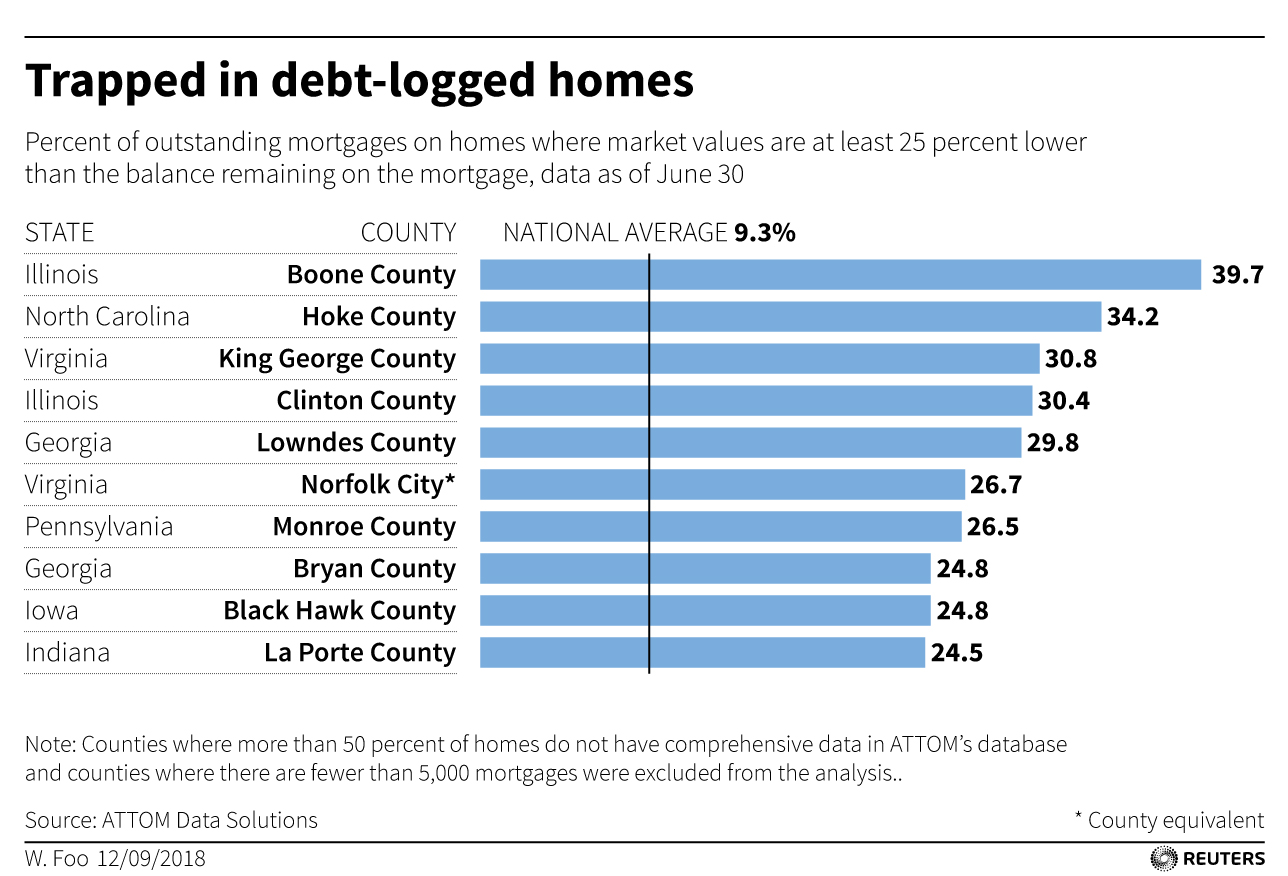
Located about 80 miles northwest of New York City in Monroe County, Pennsylvania, their home resides in one of the sickest real estate markets in the United States, according to a Reuters analysis of data provided by a leading realty tracking firm. More than one-quarter of homeowners in Monroe County are deeply “underwater,” meaning they still owe more to their lenders than their houses are worth.

The world has moved on from the global financial crisis. Hard-hit areas such as Las Vegas and the Rust Belt cities of Pittsburgh and Cleveland have seen their fortunes improve.

But the Paynes and about 5.1 million other U.S. homeowners are still living with the fallout from the real estate bust that triggered the epic downturn.

As of June 30, nearly one in 10 American homes with mortgages were “seriously” underwater, according to Irvine, California-based ATTOM Data Solutions, meaning that their market values were at least 25 percent lower than the balance remaining on their mortgages.

It is an improvement from 2012, when average prices hit bottom and properties with severe negative equity topped out at 29 percent, or 12.8 million homes. Still, it is double the rate considered healthy by real estate analysts.

“These are the housing markets that the recovery forgot,” said Daren Blomquist, a senior vice president at ATTOM.

Lingering pain from the crash is deep. But it has fallen disproportionately on commuter towns and distant exurbs in the eastern half of the United States, a Reuters analysis of county real estate data shows. Among the hardest hit are bedroom communities in the Midwest, mid-Atlantic and Southeast regions, where income and job growth have been weaker than the national norm.


Developments in outlying communities typically suffer in downturns. But a comeback has been harder this time around, analysts say, because the home-price run-ups were so extreme, and the economies of many of these Midwestern and Eastern metro areas have lagged those of more vibrant areas of the country.

“The markets that came roaring back are the coastal markets,” said Mark Zandi, chief economist at Moody’s Analytics. He said land restrictions and sales to international buyers have helped buoy demand in those areas. “In the middle of the country, you have more flat-lined economies. There’s no supply constraints. All of these things have weighed on prices.”

In addition to exurbs, military communities showed high concentrations of underwater homes, the Reuters analysis showed. Five of the Top 10 underwater counties are near military bases and boast large populations of active-duty soldiers and veterans.

Many of these families obtained financing through the U.S. Department of Veterans Affairs. The VA makes it easy for service members to qualify for mortgages, but goes to great lengths to prevent defaults. It is a big reason many military borrowers have held on to their negative-equity homes even as millions of civilians walked away.

A poor credit history can threaten a soldier’s security clearance. And those who default risk never getting another VA loan, said Jackie Haliburton, a Veterans Service Officer in Hoke County, North Carolina, home to part of the giant Fort Bragg military installation and one of the most underwater counties in the country.
“You will keep paying, no matter what, because you want to make sure you can hang on to that benefit,” Haliburton said.

These and other casualties of the real estate meltdown are easy to overlook as homes in much of the country are again fetching record prices.

But in Underwater America, homeowners face painful choices. To sell at current prices would mean accepting huge losses and laying out cash to pay off mortgage debt. Leasing these properties often won’t cover the owners’ monthly costs. Those who default will trash their credit scores for years to come.

DREAMS DEFERRED

Special education teacher Gail Payne noses her Toyota Rav 4 out of the driveway most workdays by 5 a.m. for the two-hour ride to her job in New York City’s Bronx borough.

“I hate the commute, I really, really do,” Payne said. “I’m tired.”

Now 66, she and husband Michael were counting on equity from the sale of their house to fund their retirement in Florida. For now, that remains a dream.

The Paynes’ gated community of Penn Estates, in East Stroudsburg, Pennsylvania, is among scores that sprang up in Monroe County during the housing boom.

Prices looked appealing to city dwellers suffering from urban sticker shock. But newcomers didn’t grasp how irrational things had become: At the peak, prices on some homes ballooned by more than 25 percent within months.

Today, homes that once fetched north of $300,000 now sell for as little as $72,000. But even at those prices, empty houses languish on the market. When the easy credit vanished, so did a huge pool of potential buyers.

Eight hundred miles to the west, in an unincorporated area of Boone County, Illinois, the Candlewick Lake Homeowners Association begins its monthly board meeting with the Pledge of Allegiance and a prayer.

Nearly 40 percent of the 9,800 homes with mortgages in this county about 80 miles northwest of Chicago are underwater, according to the ATTOM data. Some houses that went for $225,000 during the boom are now worth about $85,000, property records show.

By early 2010, unemployment topped 18 percent after a local auto assembly plant laid off hundreds Hof workers. At Candlewick Lake, so many people walked away from their homes that as many as a third of its houses were vacant, said Karl Johnson, chairman of the Boone County board of supervisors.

“It just got ugly, real ugly, and we are still battling to come back from it,” Johnson said.

While the local job market has recovered, signs of financial strain are still evident at Candlewick Lake. 

The community’s roads are beat up. The entryway, meeting center and fence could all use a facelift, residents say. The lake has become a weed-choked “mess,” “a cesspool,” according to residents who spoke out at an association meeting earlier this year. Association manager Theresa Balk says a recent chemical treatment is helping.

Annual homeowner’s dues of $1,136 are being stretched to pay for all the upkeep. But those fees may be a big deterrent for many would-be buyers at Candlewick Lake, said association board member Randy Bureau.

“A gated community like this, with our rules and fees, it may be just less attractive now to the general public,” he said.

Tuesday, September 4, 2018

Dozens Arrested in Marriott Worker Protests in San Francisco

Sep 3, 2018 

Hundreds of union members took to the streets of San Francisco for a Labor Day protest Monday that resulted in dozens of arrests.

An estimated 500 Marriott employees walked out to demand better pay from the hotel giant. The group marched to the Marriott hotel in Union Square, where an estimated 75 protesters were arrested for blocking traffic on Powell Street.

The protesters waved signs that read "One job is not enough," arguing Marriott employees aren’t making enough money to keep up with the rising cost of living in San Francisco. Among the workers protesting were hotel room cleaners, dishwashers and bellmen.

"One job would be enough if these greedy corporations would share some of the wealth," one protester said, adding that many of the workers need a second job to keep up.

The workers announced they’ll be holding a strike vote soon, saying their contracts expired weeks ago and claiming Marriott is making negotiation nearly impossible.

"It took them four negotiations before they gave us a counter proposal, and then on the fifth negotiation, they gave us a proposal that is actually worse than what the union won five years ago," protester Nix Guirre said.

A Marriott spokesperson released the following statement Monday afternoon:

"Marriott International’s strength is rooted in our core value of putting people first. We celebrate and thank our associates for their contribution on this Labor Day. We also respect our associates’ right to voice their opinions. Marriott International has longstanding and productive relationships with Unite Here and is negotiating in good faith and in a timely fashion to obtain the best outcomes for our associates and guests."

Monday, September 3, 2018

Trump rolls back worker safety rules

By IAN KULLGREN
09/03/2018

'We want to protect our workers,' Trump said in 2017. But his administration has weakened measures designed to keep them safe.

When President Donald Trump came into office pledging to cut regulations “massively,” he made a point of exempting regulations that protected workers’ health.

But almost two years in, the Trump administration has done the opposite, rolling back worker safety protections affecting underground mine safety inspections, offshore oil rigs and line speeds in meat processing plants, among others.

Trump's deregulatory moves on worker safety are at odds with his public stance as a champion of working class Americans, but consistent with his naming two management-side attorneys bent on rolling back economic protections for workers to the National Labor Relations Board, which regulates labor unions, and with his nominations of two reliably pro-management jurists to a now-Republican-majority Supreme Court that recently dealt a heavy financial blow to public-employee unions.

One of those Supreme Court nominees, Brett Kavanaugh, will on Tuesday begin Senate confirmation hearings, where Judiciary Committee Democrats will almost certainly quiz him about dissenting opinions in which he denied undocumented workers had the right to bargain collectively and that San Diego's Sea World bore responsibility for a deadly attack on one of its employees by a killer whale.

“When you look at core worker protections and union rights, the administration and the president have been totally anti-worker,” said Peg Seminario, director of occupational safety and health for the AFL-CIO.

To Trump, rules that protect workers — even rules that protect worker safety — are often a hindrance to boosting employment, especially in traditional industries like manufacturing and coal mining.

Deputy White House press secretary Lindsay Walters said in a written statement that the administration “is committed to protecting health and safety on the job while respecting the right of Americans to make their own decisions. Too often in the past, agencies issued regulations that constricted the freedom of American workers and small business owners to work in the best way.”

At an August campaign rally in Charleston, W.Va., the president said, “We are back. The coal industry is back.” Whether coal mining jobs are on the rebound is a matter of some dispute. But there’s no question that the Trump administration has taken steps to roll back mining safety regulations.

Trump’s mine safety chief, David Zatezalo, is a former coal executive who as recently as 2011 was cited by the agency he now leads for a pattern of safety violations. When Zatezalo was president and CEO at Rhino Resources, a West Virginia miner was killed when a portion of a rock wall collapsed. The accident occurred after Rhino already had been cited for one worker safety violation, and before it received a second.

Zatezalo, at his confirmation hearing, told senators that “the management of that particular group and that particular site was not doing what they should have been doing.”

Under the Obama administration, inspections had to occur before workers began their shifts — to scale away, for instance, loose pieces of rock that might fall on them. But in April, the Zatezalo-led Mine Safety and Health Administration said it would allow inspections to begin while miners were already at work. The change was first proposed two months before Zatezalo was confirmed.

“These additional amendments provide mine operators additional flexibility in managing their safety and health programs and reduces regulatory burdens without reducing the protections afforded miners,” MSHA wrote in the final rule.

In a written statement, a DOL spokeswoman said miners still will be notified of hazards that aren’t corrected promptly (a protection that was in the Obama rule). "MSHA believes that the additional required communication and notification," she said, "will encourage prompt corrective action and help prevent fatalities and other accidents.”

At the Interior Department, administration officials are seeking to roll back regulations on offshore oil rigs — former President Barack Obama’s response to the 2010 Deepwater Horizon blowout that killed 11 workers and flooded the Gulf of Mexico with millions of barrels of oil. A proposed rule would rescind the requirement that only government-approved third parties may inspect blowout preventers that seal a well in the event of a pressure surge.

The revisions would also allow rig operators to test equipment less frequently, to prevent “wear and tear.” All told, the changes would save industry more than $900 million over 10 years.

But environmental advocates and southern lawmakers of both parties worry the changes could lead to another deadly spill.

“History itself has demonstrated that the industry can’t be trusted to self-regulate,” said Shanna Devine, a worker health and safety advocate for Public Citizen, a consumer advocacy group. “That resulted in the same regulation the Trump administration is now trying to roll back.”

At the Agriculture Department, officials are weighing whether to raise line speeds at meat-packing plants, a change that worker advocates say would increase repetitive motion injuries and accidents. According to government data, the injury rates in meatpacking are already higher than in U.S. industries as a whole.

USDA in February proposed lifting line speed requirements in hog processing plants — part of an effort to streamline food safety inspections at the plants, which currently may process no more than 1,100 hogs per hour. Agriculture department officials wrote in the proposal that they seek to remove “unnecessary regulatory obstacles” and cut food safety inspection staff, saving taxpayers $8.7 million. The change would also would free up line inspectors to inspect other areas of the plant, they wrote.

But “common sense would tell you [that] you cannot increase line speeds at a fast, repetitive motion and not expect injuries to go up,” said Mark Lauritsen, director of meat packing and food processing for the United Food and Commercial Workers.

Increased speeds could lead to shoulder, neck, back and wrist injuries, Lauritsen said. In addition, increased line speeds could cause workers to take shortcuts in an environment that’s already dangerous.

“It’s hot, it’s humid, it’s slick, it’s bloody,” he said.

Dan Kovich, director of science and technology for the National Pork Producers Council, the industry’s chief advocacy group, says the proposal will increase line speeds in a way that will be invisible to the naked eye. He noted that the program to raise line speeds began as a pilot program under former President Bill Clinton.

As for the effect on workers, “that’s really outside our area of expertise,” Kovich said.

The Trump administration denied a similar poultry industry petition for unlimited line speed increases this year, but said it would consider applications to raise line speeds from 140 to 175 birds per minute at certain plants.

Poultry workers already face higher injury rates than manufacturing workers overall, worker advocates note. At a plant in Maryland in 2014, government researchers found that more than one-third of workers suffered from carpal tunnel syndrome. Many more don’t report dangerous conditions due to fear of retaliation, according to the Government Accountability Office, making it hard for the government to accurately assess the scope of the problem.

Officials at USDA’s Food Safety and Inspection Service said they worked with the worker safety arm of the Centers for Disease Control and Prevention in developing the updated inspection proposals. In addition, they said, plants seeking increases must agree to monitor injuries.

But USDA food safety officials acknowledge that safety wasn’t a top priority. “We don’t regulate worker safety,” acting administrator Paul Kiecker said. “What we regulate at FSIS is the food safety. That’s not to say we are not interested in employee safety. We are definitely interested in that.”

The National Chicken Council, the main advocacy group for the poultry industry, noted that injury rates among workers have fallen over the past two decades.

At the Occupational Safety and Health Administration, Trump officials are seeking to loosen reporting requirements for injury and illness data from large companies. A rule proposed in July in would relieve companies with 250 workers or more from a previous obligation to submit detailed injury and illness data, which OSHA had intended to publish online.

“Companies will have an easier time hiding injuries and illnesses,” said Debbie Berkowitz, a former Obama OSHA official and director of worker safety and health for the National Employment Law Project. “This is on top of the fact that OSHA’s presence in the workplace is declining.”

A NELP study released in June found that OSHA enforcement fell from 2017 to 2018, after Trump took office.

Under the proposal, companies still must submit summaries of the data to OSHA for review. The U.S. Chamber of Commerce says the proposal should go further, arguing that proprietary information — such as hours and number of workers — could be of value to competitors.

“It leaves a big, glaring weakness exposed,” said Marc Freedman, the Chamber’s vice president of employment policy.

The Labor Department spokeswoman said the proposal “would protect both the safety and the privacy of America’s workers.”

“Injury and illness data must still be reported and posted in individual establishments and will continue to be used for enforcement purposes,” she said in a written statement. “The proposed rule would protect workers’ personally identifiable information and sensitive medical information from Freedom of Information Act inquiries. The proposal would not change the existing requirements for the electronic submission of summaries of work-related injuries and illnesses each year.”

Since Trump took office, OSHA also scrubbed a running list of worker deaths from its home page.

A notable exception to the administration’s resistance to worker-safety regulation was its decision to defend in court an Obama-era rule regulating crystalline silica — a mineral dust long known to cause deadly lung ailments. After some initial delays, the rule took effect for most employers in June.

That action was more in tune with Trump's earlier rhetoric. "We need regulations for safety and environment and things,” President-elect Trump assured workers at an Indianapolis air-conditioner plant in December 2016. “We want to protect our workers,” President Trump repeated one year later in a speech touting the cancellation or delay of 1,500 regulatory actions.

At EPA, Trump officials are working on new rules to limit asbestos exposure as part of a congressionally mandated update to the Toxic Substances Control Act in 2016. On its face, it would seem to be strengthening safety.

But advocates worry that the rules, intended by Congress to limit asbestos, could open the door to new products containing the toxin.

EPA’s significant new use rule, proposed in June, lists 14 uses of asbestos that would trigger scrutiny by EPA. All were used at one time but have been halted by industry voluntarily, said Betsy Southerland, former director of the EPA’s science and technology office.

But the rule doesn’t require every new use of asbestos to be approved by the EPA, though advocates believe Congress gave the agency authority to do so. That means a company conceivably could develop at new use for asbestos and not have to notify the agency, said Southerland, who resigned in 2017.

“You never know what industry is going to come up with,” Southerland said. “They could want to use it to create new chemicals in the future.”

In addition, the EPA’s proposal for evaluating asbestos risks doesn’t consider so-called legacy hazards — for example, particles of asbestos insulation or asbestos tiles that could be inhaled by workers when removed. That means workers could be more highly exposed than the general public if and when the EPA approves new uses.

“What the Trump EPA has done is essentially cooked the books to undervalue the risks posed by asbestos,” said Scott Faber, a top lobbyist for the Environmental Working Group, which has opposed a variety of Trump policies. “You don’t need to be a toxicologist to understand that you can’t determine whether a chemical is safe or not if you don’t understand the whole picture.”

EPA spokeswoman Molly Block noted that the proposal was subject to multiple rounds of public comments.

“Based on that input, the agency is confident that the uses identified in the SNUR constitute the universe of uses that could come back onto the market if someone wanted to reintroduce the use,” Block said in a statement. “Thus the proposed [significant new use rule] is a good complement to the risk evaluation.”

Advocates suspect industry influence may have played a role. Nancy Beck, a deputy assistant administrator the EPA’s Office of Chemical Safety and Pollution Prevention, previously served as the senior director for regulatory science policy for the American Chemistry Council, a trade group representing the chemical industry. Block noted that Beck, who declined to be interviewed, worked in the EPA under President George W. Bush and in the White House Office of Management and Budget under Bush and Obama.

“The amount of time and energy they put into rolling back this vital worker health and safety protections could have easily been put into implementing existing protections and enacting new rules that are needed,” said Devine, the Public Citizen advocate. “This Labor Day, it’s clear where the administration’s interests lie.”


=================================

Cheap labor in unsafe conditions, unpaid overtime, toxic pollution, and no healthcare. Worker safety should take a back seat to profits of company executives. Turning America into China.

Thursday, August 30, 2018

Trump cancels pay raise due to federal workers in January

By DARLENE SUPERVILLE
August 30, 2018

WASHINGTON (AP) — President Donald Trump is canceling pay raises due in January for most civilian federal employees, he informed Congress on Thursday, citing budget constraints. But the workers still could see a slightly smaller boost in their pay under a proposal lawmakers are considering.

Trump said he was nixing a 2.1 percent across-the-board raise for most workers as well as separate locality pay increases averaging 25.7 percent.

“We must maintain efforts to put our Nation on a fiscally sustainable course, and Federal agency budgets cannot sustain such increases,” said Trump. The president last year signed a package of tax cuts that is forecast to add about $1.5 trillion to federal deficits over 10 years.

Trump cited the “significant” cost of employing federal workers as justification for denying the pay increases, and called for federal worker pay to be based on performance and structured toward recruiting, retaining and rewarding “high-performing Federal employees and those with critical skill sets.”

His announcement came as the country heads into the Labor Day holiday weekend.

Democrats immediately criticized the move, citing the tax cuts Trump signed into law last December. That law provided steep tax cuts for corporations and the wealthiest Americans, and more modest reductions for middle- and low-income individuals and families.

“Trump has delivered yet another slap in the face to American workers,” said Democratic National Committee Chairman Tom Perez.

Under the law, the 2.1 percent raise takes effect automatically unless the president and Congress act to change it. Congress is currently debating a proposal for a slightly lower, 1.9 percent across-the-board raise to be included in a funding bill that would require Trump’s signature to keep most government functions operating past September.

Unions representing the 2 million-member federal workforce urged Congress to pass the 1.9 percent pay raise.

“President Trump’s plan to freeze wages for these patriotic workers next year ignores the fact that they are worse off today financially than they were at the start of the decade,” said J. David Cox Sr., president of the American Federation of Government Employees, which represents some 700,000 federal workers.

“They have already endured years of little to no increases and their paychecks cannot stretch any further as education, health care costs, gas and other goods continue to get more expensive,” added Tim Reardon, national president of the National Treasury Employees Union.

Cox said federal worker pay and benefits have been cut by more than $200 billion since 2011.


Congress has approved legislation to give military service members a 2.6 percent pay raise, the biggest in nine years, but funding for the pay raise has not yet been approved.

In July, the Trump administration sharply revised upward its deficit estimates compared to the estimates in the budget proposal it sent Congress in February. The worsening deficit reflects the impact of the $1.5 trillion, 10-year tax cut, as well as increased spending for the military and domestic programs that Congress approved earlier this year.

The administration’s July budget update projected a deficit of $890 million for the fiscal year that ends Sept. 30, up from the February estimate of $873 billion. The $890 billion projection represents a 34 percent increase from the $666 billion in 2017.

For 2019, the administration is projecting the deficit will top $1 trillion and stay above that level for the next three years.

The only other period when the federal government ran deficits above $1 trillion was the four years from 2009 through 2012, when the government used tax cuts and increased spending to combat the 2008 fiscal crisis and the worst economic downturn since the 1930s.

Rep. Gerry Connolly, D-Va., who represents many federal workers, blamed what he said was Trump’s mismanagement of federal government.

“His tax bill exploded the deficit, and now he is trying to balance the budget on the backs of federal workers,” Connolly said.


=======================================

Shame on Trump denying blue collars 2.1% raise. Trump claimed the economy is skyrocketing - if it is true, then why deny a 2.1% raise to blue collar!

Longtime Trump driver's overtime lawsuit moved to private arbitration

Brendan Pierson
August 30, 2018


NEW YORK (Reuters) - A lawsuit by a former personal driver for U.S. President Donald Trump who has claimed that Trump’s company failed to pay him for thousands of hours of overtime has been moved from federal court to private arbitration, the man’s lawyer said on Thursday.

The man, Noel Cintron, claimed in his lawsuit last month the Trump Organization had not paid him for 3,300 hours of overtime in the previous six years. He filed a notice in Manhattan federal court on Thursday that he was dropping the lawsuit.

Larry Hutcher, a lawyer for Cintron, said the dispute had been transferred to private arbitration but did not comment further.

A spokeswoman for the Trump Organization did not immediately respond to a request for comment. The company said in a statement last month that Cintron “was at all times paid generously and in accordance with the law.”

Trump was not a defendant in the lawsuit.

Cintron’s lawsuit had claimed that the unpaid overtime totaled $178,000, at $54.09 per hour, and could have been higher but for a statute of limitations. Cintron sought damages that his lawyer said at the time could reach $400,000.

Cintron said he drove for Trump, his family members and his businesses for more than a quarter century, averaging 50 to 55 hours weekly, until the Secret Service took over driving responsibilities in 2016.

He said his salary was raised to $68,000 in 2006 and then to $75,000 in 2010, but the latter increase required him to surrender health benefits. Cintron said this saved Trump $17,866 in annual health insurance premiums.

Saturday, August 25, 2018

U.S. judge rejects Trump directives easing ability to fire federal workers

Reuters Staff
AUGUST 25, 2018 

WASHINGTON (Reuters) - A U.S. federal judge on Saturday rejected key elements of President Donald Trump’s May executive orders that would make it easier to fire federal employees and reduce their ability to bargain collectively.

Judge Ketanji Brown Jackson, of the U.S. District Court for the District of Columbia, said in a court order that Trump’s orders, which also would reduce the amount of time low-performing employees had to improve their performance before being fired, “undermine federal employees’ right to bargain collectively.”

Trump signed three executive orders in May that administration officials said would give government agencies greater ability to remove employees with “poor” performance, obtain “better deals” in union contracts and require federal employees with union responsibilities to spend less time on union work.

The directives drew immediate criticism from the American Federation of Government Employees, which said the moves would hurt veterans, law enforcement officers and others.

Jackson ruled that while the president has the authority to issue executive orders relating to federal labor relations, the orders cannot “eviscerate the right to bargain collectively” as envisioned in a long-standing federal statute.

“The President must be deemed to have exceeded his authority in issuing (the orders),” Jackson ruled.