By Linda Qiu on Friday, July 15th, 2016
Provocative rhetoric to "make America great again" fueled Donald Trump’s ascent to the Republican nomination, a status that will be made official this week at the Republican National Convention in Cleveland.
So how would Trump do that? His campaign promises are aimed at changes to immigration, trade, taxes and foreign policy.
While Trump has made some unorthodox to-dos — such as refusing to take vacations, rejecting the narratives of the elites, and having the country say "Merry Christmas" again — many of his pledges are fairly conventional.
Promises to cut taxes and fight terrorists are the type of promises any politician might make, said Larry Sabato, who directs the Center for Politics at the University of Virginia.
"But this has been overshadowed by his unusual profile and approach," Sabato said.
PolitiFact has been collecting Trump’s campaign promises from his website and public comments. We’re also following the promises of Democratic nominee Hillary Clinton and will track the promises of the new president whoever it is. We currently track President Barack Obama’s campaign promises on our Obameter.
We identified Trump’s 10 key promises (we’ll look at Clinton’s next week) and ran them by experts in their subjects. They told us Trump will face significant hurdles to actually achieve the agenda he is setting.
1. ‘Build a wall’ — and make Mexico pay for it
Trump announced his candidacy with the promise "to build a great, great wall on our southern border" and "have Mexico pay for that wall," and has repeated the call with conviction and consistency. But even his supporters have expressed skepticism that this centerpiece promise will see the light of day. An actual wall will be extremely costly, and it remains to be seen how Trump would force Mexico to pay for it.
"There are some that hear this is going to be 1,200 miles from Brownsville to El Paso, 30-foot high, and listen, I know you can’t do that," former Texas Gov. Rick Perry said recently. (Perry once denounced Trump but has since endorsed him.)
2. Temporarily ban Muslims from entering the United States
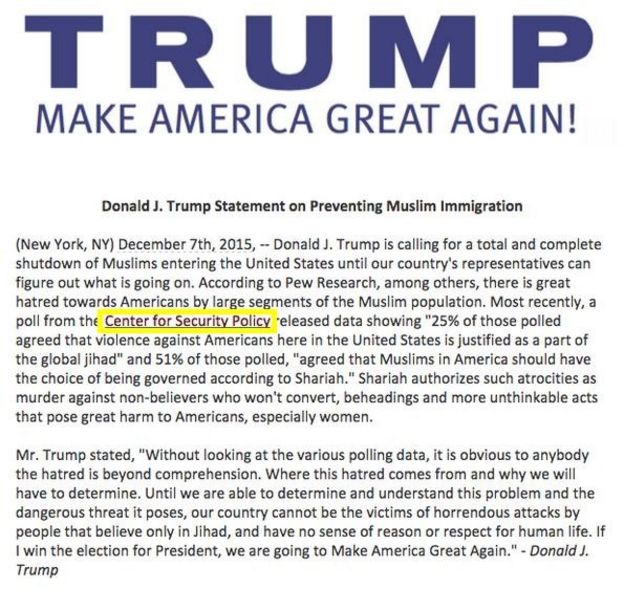
Following the December 2015 shooting in San Bernardino, Calif., Trump called for "a total and complete shutdown of Muslims entering the United States until our country’s representatives can figure out what is going on."
The next day, Trump admitted that details "would have to worked out" and said it wouldn’t apply to all Muslims, but remained vague on the timeline or the exemptions. Scholars were divided on whether banning people of an entire faith would violate the constitution.
In early May, Trump told the New York Times the ban would be in place by the end of his first 100 days in office. But on Fox News Radio a few days later, he said that it was "just a suggestion." A month later, he recommitted to the ban, tweaking it to now encompass immigrants from "nations tied to Islamic terror."
3. ‘Bring manufacturing (jobs) back’
Trump has said he will revitalize manufacturing in various iterations (i.e. "I’m going to be the greatest jobs president God ever created") and laid out how in his June 28 speech on the economy.
"I am going to withdraw the United States from the Trans-Pacific Partnership (and) I’m going tell our NAFTA partners that I intend to immediately renegotiate the terms of that agreement to get a better deal for our workers," he said. "I will use every lawful presidential power to remedy trade disputes, including the application of tariffs."
But most experts say that Trump wouldn’t be able to bring back all 4 million lost manufacturing jobs, which have been declining since the 1940s, well before the modern era of free trade deals and China’s economic rise.
"The short answer is that a small number of manufacturing jobs could be brought back, but probably at enormous cost," Alan Blinder, a Princeton University economist who specializes in employment and trade and member of President Bill Clinton’s Council of Economic Advisors.
Susan Houseman, an economist with the W.E. Upjohn Institute, commended some of Trump’s proposals but said the issue is way more complex than Trump describes.
"The devil is in the details, which of course are entirely absent from Trump's speech and policy positions," she said, adding that suddenly changing trade policies and tariffs could actually lead to job losses.
Harry Moser, president of the Reshoring Initiative, is more optimistic that Trump could deliver, but said Trump would have to be in it for the long haul:"You can’t do it in a day, you can’t do it a year. I’d be delighted if we can do it in a decade or two."
4. Impose tariffs on goods made in China and Mexico
Warren Maruyama, a former general counsel to the U.S. Trade Representative under Presidents George W. Bush and Barack Obama, told us President Trump would have the authority under a variety of trade statutes to impose higher tariffs, but added "it would lead to a trade war and cost hundreds and thousands of jobs."
Hal Shapiro, an attorney specializing in international trade practice, pointed to Section 301 of the Trade Act of 1974 which gives the president the power to impose retaliatory tariffs on countries that violate trade agreements or engage in unfair trade practices under. But Shapiro said he can’t think of "a single instance" where a U.S. company offshoring is considered an unfair trade practice by the foreign country.
Trump’s promise also violates international trade rules, and he’s yet to propose exiting the World Trade Organization. So assuming the United States stays in the club, Beijing and Mexico City wouldn’t take his blanket tariffs lying down and would almost certainly retaliate.
5. Renegotiate or withdraw from the North American Free Trade Agreement and Trans-Pacific Partnership
Trump has been most critical of NAFTA and TPP, pinning them to Clinton and past and future job losses.
President Trump would have the authority to bow out of the North American Free Trade Agreement and the Trans Pacific Partnership. But such a move may not increase American manufacturing jobs; an expert told us that leverage works in both directions.
"Countries like Mexico and Canada would have a list of things they’d want from the United States," Alan Wolff, a former U.S. deputy trade representative under President Jimmy Carter. "These are balanced, hard-to-negotiate agreements."
6. ‘Full repeal of Obamacare’ and replace it with a market-based alternative
Trump’s call to repeal Obamacare and replace it with a marketplace alternative is popular among rank-and-file Republicans. Larger majorities in Congress would be needed for repeal.
"If a Trump win is accompanied by Republican control of both houses of Congress, then some significant rollback is feasible and likely," said John McDonough, a health policy professor at Harvard University.
7. Renegotiate the Iran deal
Similarly, Trump has a shot at delivering on his promise to "renegotiate with Iran" even though Iran has said it won’t revisit the issue. Mark Dubowitz, executive director of the nonpartisan Foundation for Defense of Democracies, sees Iran’s attitude as posturing and pointed out that there’s precedent for a follow-up talk.
"The Iranians are continuing to negotiate, demanding significant economic concessions," Dubowitz said. "I have confidence both (Trump and Clinton) could renegotiate a better deal."
8. Leave Social Security as is
Trump has said repeatedly that voters like Social Security, so it should be left alone. Unlike most of his primary rivals, Trump vowed to leave the retirement age and benefits intact.
"There’s no way a Republican is going to beat a Democrat when the Republican is saying, 'We’re going to cut your Social Security’ and the Democrat is saying, 'We’re going to keep it and give you more,’ " Trump reportedly told House Speaker Paul Ryan, who wants entitlement cuts, in May.
But beyond calling for a crackdown on fraud and waste, Trump hasn’t specified how exactly he would save the program. He claims that his economic proposals would preserve Social Security by "making the country rich again," though that’s not supported by multiple analyses.
Trump’s commitment to this promise may also be wavering. His policy advisor Sam Clovis told Reuters in May that Trump would be open to changes to Social Security if elected.
9. Cut taxes
Under Trump’s proposed tax reforms, everyone would indeed get a cut. (The top 0.1 percent would receive more tax relief than the bottom 60 percent of taxpayers combined.)
Trump’s plan would bloat the federal deficit by at least $10 trillion over the next decade, even if you factor in economic growth. This makes his promise of protecting Social Security harder to keep, given the program is one of the biggest line items in the budget.
On average, experts scored the Trump tax plan’s chances of passing as a D. The campaign has said the details of his tax plan are subject to change, and would soon announce a new policy. It hasn’t yet done so.
10. ‘Bomb’ and/or ‘take the oil’ from ISIS
A twist on his decade-old idea to seize Middle Eastern oil as repayment, Trump repeatedly makes this promise on the campaign trail, arguing it’ll cut off funding to ISIS.
The United States has already been bombing oil assets under ISIS control for quite some time, though.
"It’s like saying there won’t be a meteor strike in 1812," said Anthony Cordesman, a national security analyst at the Center for Strategic and International Studies.
As for how he would "take the oil," Trump told the Washington Post’s editorial board in March he would "circle" and "defend those areas" with ground troops, but wouldn’t commit to a number.
To keep this promise, Trump would have to invade Syria and convince the Assad regime to give up their claims on oil and gas in the country, according to Matthew Reed, vice president of Foreign Reports, a consultant firm specializing in Middle East oil politics
"If Trump wants to take oil from ISIS, he needs an invasion plan and an occupation plan covering years, plus a reconstruction plan worth billions of American dollars," Reed said.
Given that the United States and its allies have been systematically taking territory from ISIS without resorting to a full-scale invasion, Cordesman called the promise "purposeless" and "imbecilic."
The value of vague promises
Overall, Trump’s appeal may not be rooted in what he says he’ll do — rather it’s in the rhetoric itself.
The wall and Muslim ban, for example, are unrealistic, said Sabato of the University of Virginia, "but both these pledges got Trump airborne and still sustain him. As long as non-college, blue-collar whites like the sound of these promises, Trump will keep repeating them."
Some of Trump’s positions are actually in line with those of Clinton, such as protecting Social Security and increased skepticism toward trade.
Trump’s lack of detailed pledges and firm stances may be advantageous.
"Voters generally do not punish candidates for being vague, and in partisan elections voters actually prefer ambiguous candidates over precise ones," Stanford University political scientists Michael Tomz and Robert Van Houweling found in a study. "The reason, we find, is that ambiguity allows voters to 'see what they want to see’ in members of their own party."
Trump himself put it best in February: "Everything is negotiable."
====================================
To those who believe in the above promises
"There's a sucker born every minute" is a phrase closely associated with P. T. Barnum, an American showman of the mid-19th century