Sunday, July 17, 2016

Priebus wrongly says no Bush attended 2012 RNC

July 17th, 2016 

Republican National Committee chairman Reince Priebus is confident the Cleveland RNC will be a success, even without a Bush in attendance.

Former Florida Gov. Jeb Bush and former presidents George W. and George H.W. Bush all declined to participate or attend the 2016 nominating convention. Meet the Press host Chuck Todd offered the decision of the Bush family to spurn the 2016 convention as evidence that this year’s event will be a little different.

"You’re not showcasing the best parts of your party," Todd said to Priebus, adding "it is unusual not to have a Bush at the convention."

Priebus responded: "It didn’t happen four years ago" at the 2012 RNC in Tampa. Priebus added after some back-and-forth that that "there was no President Bush" at the RNC in 2008.

Claims about the pre-eminence of the Bush family in Republican politics have come up before. We previously rated True a claim that Republicans haven’t won an election without a Bush or Nixon since 1928.

In this case we wondered if Priebus was right that the Bush family eschewed the RNC in some form in 2012 and 2008.

He wasn’t.

The 2012 convention

It’s been nearly eight years since a Bush has held national elected office, but the family has maintained a role at the nominating convention. Since 1980, every Republican convention has seen a Bush speak — often as the vice presidential or presidential nominee.

That includes the 2012 convention in Tampa, which saw the nomination of Mitt Romney.

Jeb Bush addressed delegates at the convention, as this video confirms. He touted his love for his brother, criticized President Barack Obama’s record and discussed children and education.

"If we want to continue to be the greatest nation on the planet, we must give our kids what we promised them — an equal opportunity," he said. "That starts in the classroom. It starts in our communities. It starts where you live and it starts with nominating Mitt Romney the next president of the United States."

2000, 2004 and 2008

Priebus also contended in his interview with Todd that there was no "President Bush" at the 2008 RNC in St. Paul, Minn.

That’s not entirely correct, either. President George W. Bush addressed convention delegates live from the White House. Bush told convention delegates that he remained in Washington to oversee recovery efforts related to Hurricane Gustav.

Bush, however, praised GOP nominee Arizona Sen. John McCain.

"He is ready to lead this nation," Bush said. "From the day of his commissioning John McCain was a respected Naval officer who made decisions on which the lives of others depended."

First Lady Laura Bush spoke live from the convention, which also included appearances by former President George H.W. Bush and former First Lady Barbara Bush, video from the event shows.

George W. Bush, the 2004 GOP nominee, of course spoke at the New York City 2004 convention as well, as did Laura Bush. Same for 2000 in Philadelphia, Pennsylvania.

1980, 1984, 1988, 1992 and 1996

The list goes on.

Former president George H.W. Bush spoke at the 1996 convention in San Diego, Calif., which eventually nominated former Kansas Sen. Bob Dole.

George H.W. Bush spoke in Houston, Texas, for the 1992 convention, as part of his failed re-election campaign.The same goes for 1988, when he was named the Republican nominee for the first time.

In 1984, George H. W. Bush was selected as the vice-presidential nominee (Ronald Reagan was nominated for president). The same thing happened in 1980, and Bush spoke on both occasions.

The earliest convention we could find without a Bush speaking was in 1976, where Gerald Ford was selected as the Republican nominee.

To recap, that’s at least 40 years and nine conventions where a Bush had a speaking role. And members of the Bush family definitely spoke at both the 2012 and 2008 conventions.

Our ruling

Priebus said it’s not a big deal a Bush isn’t attending the 2016 convention, because a Bush didn’t speak in 2012 and "there was no President Bush" at the 2008 convention.

He’s wrong. Jeb Bush addressed delegates at the 2012 Republican National Convention in Tampa. In 2008, George W. Bush addressed delegates via a live video feed, but former President George H.W. Bush and former first ladies Laura and Barbara Bush all attended.

A Bush has spoken at every RNC since at least 1980, we found.


We rate this claim False.

Saturday, July 16, 2016

Donald Trump's top 10 campaign promises

By Linda Qiu on Friday, July 15th, 2016

Provocative rhetoric to "make America great again" fueled Donald Trump’s ascent to the Republican nomination, a status that will be made official this week at the Republican National Convention in Cleveland.

So how would Trump do that? His campaign promises are aimed at changes to immigration, trade, taxes and foreign policy.

While Trump has made some unorthodox to-dos — such as refusing to take vacations, rejecting the narratives of the elites, and having the country say "Merry Christmas" again — many of his pledges are fairly conventional.

Promises to cut taxes and fight terrorists are the type of promises any politician might make, said Larry Sabato, who directs the Center for Politics at the University of Virginia.

"But this has been overshadowed by his unusual profile and approach," Sabato said.

PolitiFact has been collecting Trump’s campaign promises from his website and public comments. We’re also following the promises of Democratic nominee Hillary Clinton and will track the promises of the new president whoever it is. We currently track President Barack Obama’s campaign promises on our Obameter.

We identified Trump’s 10 key promises (we’ll look at Clinton’s next week) and ran them by experts in their subjects. They told us Trump will face significant hurdles to actually achieve the agenda he is setting.

1. ‘Build a wall’ — and make Mexico pay for it

Trump announced his candidacy with the promise "to build a great, great wall on our southern border" and "have Mexico pay for that wall," and has repeated the call with conviction and consistency. But even his supporters have expressed skepticism that this centerpiece promise will see the light of day. An actual wall will be extremely costly, and it remains to be seen how Trump would force Mexico to pay for it.

"There are some that hear this is going to be 1,200 miles from Brownsville to El Paso, 30-foot high, and listen, I know you can’t do that," former Texas Gov. Rick Perry said recently. (Perry once denounced Trump but has since endorsed him.)

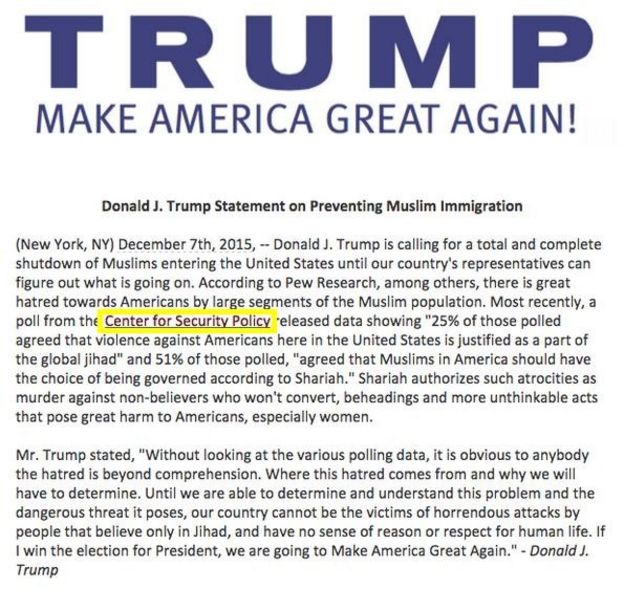
2. Temporarily ban Muslims from entering the United States

Following the December 2015 shooting in San Bernardino, Calif., Trump called for "a total and complete shutdown of Muslims entering the United States until our country’s representatives can figure out what is going on."

The next day, Trump admitted that details "would have to worked out" and said it wouldn’t apply to all Muslims, but remained vague on the timeline or the exemptions. Scholars were divided on whether banning people of an entire faith would violate the constitution.

In early May, Trump told the New York Times the ban would be in place by the end of his first 100 days in office. But on Fox News Radio a few days later, he said that it was "just a suggestion." A month later, he recommitted to the ban, tweaking it to now encompass immigrants from "nations tied to Islamic terror."

3. ‘Bring manufacturing (jobs) back’

Trump has said he will revitalize manufacturing in various iterations (i.e. "I’m going to be the greatest jobs president God ever created") and laid out how in his June 28 speech on the economy.

"I am going to withdraw the United States from the Trans-Pacific Partnership (and) I’m going tell our NAFTA partners that I intend to immediately renegotiate the terms of that agreement to get a better deal for our workers," he said. "I will use every lawful presidential power to remedy trade disputes, including the application of tariffs."

But most experts say that Trump wouldn’t be able to bring back all 4 million lost manufacturing jobs, which have been declining since the 1940s, well before the modern era of free trade deals and China’s economic rise.

"The short answer is that a small number of manufacturing jobs could be brought back, but probably at enormous cost," Alan Blinder,  a Princeton University economist who specializes in employment and trade and member of President Bill Clinton’s Council of Economic Advisors.

Susan Houseman, an economist with the W.E. Upjohn Institute, commended some of Trump’s proposals but said the issue is way more complex than Trump describes.

"The devil is in the details, which of course are entirely absent from Trump's speech and policy positions," she said, adding that suddenly changing trade policies and tariffs could actually lead to job losses.

Harry Moser, president of the Reshoring Initiative, is more optimistic that Trump could deliver, but said Trump would have to be in it for the long haul:"You can’t do it in a day, you can’t do it a year. I’d be delighted if we can do it in a decade or two."

4. Impose tariffs on goods made in China and Mexico

Warren Maruyama, a former general counsel to the U.S. Trade Representative under Presidents George W. Bush and Barack Obama, told us President Trump would have the authority under a variety of trade statutes to impose higher tariffs, but added "it would lead to a trade war and cost hundreds and thousands of jobs."

Hal Shapiro, an attorney specializing in international trade practice, pointed to Section 301 of the Trade Act of 1974 which gives the president the power to impose retaliatory tariffs on countries that violate trade agreements or engage in unfair trade practices under. But Shapiro said he can’t think of "a single instance" where a U.S. company offshoring is considered an unfair trade practice by the foreign country.

Trump’s promise also violates international trade rules, and he’s yet to propose exiting the World Trade Organization. So assuming the United States stays in the club, Beijing and Mexico City wouldn’t take his blanket tariffs lying down and would almost certainly retaliate.

5. Renegotiate or withdraw from the North American Free Trade Agreement and Trans-Pacific Partnership

Trump has been most critical of NAFTA and TPP, pinning them to Clinton and past and future job losses.

President Trump would have the authority to bow out of the North American Free Trade Agreement and the Trans Pacific Partnership. But such a move may not increase American manufacturing jobs; an expert told us that leverage works in both directions.

"Countries like Mexico and Canada would have a list of things they’d want from the United States," Alan Wolff, a former U.S. deputy trade representative under President Jimmy Carter. "These are balanced, hard-to-negotiate agreements."

6. ‘Full repeal of Obamacare’ and replace it with a market-based alternative

Trump’s call to repeal Obamacare and replace it with a marketplace alternative is popular among rank-and-file Republicans. Larger majorities in Congress would be needed for repeal.

"If a Trump win is accompanied by Republican control of both houses of Congress, then some significant rollback is feasible and likely," said John McDonough, a health policy professor at Harvard University.

7. Renegotiate the Iran deal

Similarly, Trump has a shot at delivering on his promise to "renegotiate with Iran" even though Iran has said it won’t revisit the issue. Mark Dubowitz, executive director of the nonpartisan Foundation for Defense of Democracies, sees Iran’s attitude as posturing and pointed out that there’s precedent for a follow-up talk.

"The Iranians are continuing to negotiate, demanding significant economic concessions," Dubowitz said. "I have confidence both (Trump and Clinton) could renegotiate a better deal."

8. Leave Social Security as is

Trump has said repeatedly that voters like Social Security, so it should be left alone. Unlike most of his primary rivals, Trump vowed to leave the retirement age and benefits intact.

"There’s no way a Republican is going to beat a Democrat when the Republican is saying, 'We’re going to cut your Social Security’ and the Democrat is saying, 'We’re going to keep it and give you more,’ " Trump reportedly told House Speaker Paul Ryan, who wants entitlement cuts, in May.

But beyond calling for a crackdown on fraud and waste, Trump hasn’t specified how exactly he would save the program. He claims that his economic proposals would preserve Social Security by "making the country rich again," though that’s not supported by multiple analyses.
Trump’s commitment to this promise may also be wavering. His policy advisor Sam Clovis told Reuters in May that Trump would be open to changes to Social Security if elected.

9. Cut taxes

Under Trump’s proposed tax reforms, everyone would indeed get a cut. (The top 0.1 percent would receive more tax relief than the bottom 60 percent of taxpayers combined.)

Trump’s plan would bloat the federal deficit by at least $10 trillion over the next decade, even if you factor in economic growth.  This makes his promise of protecting Social Security harder to keep, given the program is one of the biggest line items in the budget.

On average, experts scored the Trump tax plan’s chances of passing as a D. The campaign has said the details of his tax plan are subject to change, and would soon announce a new policy. It hasn’t yet done so.

10. ‘Bomb’ and/or ‘take the oil’ from ISIS

A twist on his decade-old idea to seize Middle Eastern oil as repayment, Trump repeatedly makes this promise on the campaign trail, arguing it’ll cut off funding to ISIS.

The United States has already been bombing oil assets under ISIS control for quite some time, though.

"It’s like saying there won’t be a meteor strike in 1812," said Anthony Cordesman, a national security analyst at the Center for Strategic and International Studies.

As for how he would "take the oil," Trump told the Washington Post’s editorial board in March he would "circle" and "defend those areas" with ground troops, but wouldn’t commit to a number.

To keep this promise, Trump would have to invade Syria and convince the Assad regime to give up their claims on oil and gas in the country, according to Matthew Reed, vice president of Foreign Reports, a consultant firm specializing in Middle East oil politics

"If Trump wants to take oil from ISIS, he needs an invasion plan and an occupation plan covering years, plus a reconstruction plan worth billions of American dollars," Reed said.
Given that the United States and its allies have been systematically taking territory from ISIS without resorting to a full-scale invasion, Cordesman called the promise "purposeless" and "imbecilic."

The value of vague promises

Overall, Trump’s appeal may not be rooted in what he says he’ll do — rather it’s in the rhetoric itself.

The wall and Muslim ban, for example, are unrealistic, said Sabato of the University of Virginia, "but both these pledges got Trump airborne and still sustain him. As long as non-college, blue-collar whites like the sound of these promises, Trump will keep repeating them."

Some of Trump’s positions are actually in line with those of Clinton, such as protecting Social Security and increased skepticism toward trade.

Trump’s lack of detailed pledges and firm stances may be advantageous.

"Voters generally do not punish candidates for being vague, and in partisan elections voters actually prefer ambiguous candidates over precise ones," Stanford University political scientists Michael Tomz and Robert Van Houweling found in a study. "The reason, we find, is that ambiguity allows voters to 'see what they want to see’ in members of their own party."

Trump himself put it best in February: "Everything is negotiable."


====================================

To those who believe in the above promises 


"There's a sucker born every minute" is a phrase closely associated with P. T. Barnum, an American showman of the mid-19th century

Friday, July 15, 2016

NLRB: Unions may organize permanent and temporary workers without employers' consent

7/14/2016

In a decision that will affect staffing companies and the employers that use them, the National Labor Relations Board (“NLRB”) has smoothed the path for unions that seek to organize and represent permanent and temporary employees working at the same worksite.

The July 11, 2016, decision overturns an eight-year-old rule that had required all employers with employees at a particular worksite to agree before a union could represent their workers as one bargaining unit.  Under the new rule, unions may secure a workplace election to decide if a proposed bargaining unit meets the shared-interest standards applied to proposed bargaining units in all workplaces, regardless of whether the proposed unit includes workers employed by different employers.

The dispute began in 2012, when a union sought to represent a bargaining unit made up of two groups of sheet-metal workers – those who were directly employed by a Pennsylvania manufacturer (the “user employer”) and those who were employed by a different company (the “supplier employer”) but were assigned to work at the manufacturer.  The regional office rejected the union’s attempt to organize both groups of employees together, deciding that a rule adopted by the Board in 2004 required the consent of both employers for the election to proceed.  The July 11 decision of the NLRB overruled the regional office, overturned the 2004 rule, and directed that the union could proceed with the election.

Going forward, user employers should keep in mind:
*The importance of engaging reputable and experienced staffing companies.
*The value of strong communication with supplier-employer partners.  Under the new rule, it is more likely that user employers and supplier employers will be bargaining partners when dealing with unions.  Discord between the employers could give unions “divide and conquer” leverage.

Supplier employers should be mindful of:
*The need for consistent, frequent and clear communication with their clients on possible union issues.
*The fact that some industries (health care, production, janitorial, drivers) are more likely than others to be identified for union organizing.
*The value of strong communication with user-employer partners, to avoid the sort of discord that could give unions “divide and conquer” leverage.

And supplier and user employers both should consider:
*Union representation elections now are held under the accelerated rules adopted in 2014 – meaning joint-employer issues will need to be identified and addressed promptly if a union files a petition for election.

The recent decision reflects how the political makeup of the NLRB – the majority of which is appointed by the sitting president – can create uncertainty for employers evaluating how to respond to union petitions for election: This week’s decision overturned a decision issued in 2004 by a Board with a Republican Party majority – which in turn had overturned a decision issued only four years earlier, in 2000, by a Board with a Democratic Party majority.


The case is Miller & Anderson, Inc., 364 NLRB No. 39 (July 11, 2016), and is available here.  Several labor unions and commercial and industry groups, including the U.S. Chamber of Commerce and the American Staffing Association, filed legal arguments with the NLRB prior to its decision.

No Strike: San Francisco City College, Unions Reach Accord

By California Patch
July 14, 2016

San Francisco, CA - City College of San Francisco officials today announced a tentative contract agreement with the faculty union that averts a threatened strike and gives faculty their first real pay increase since 2007.

The deal includes a mix of ongoing salary increases and one-time raises that restore a salary cut taken in 2011-12 and increase salaries by at least 6.7 percent over a three-year period, according to district officials.

That amount could be higher if the district is successful in restoring enrollment after a recent decline caused by problems in the district's accreditation.

"We are pleased to have reached a tentative agreement with our faculty that provides as much of an ongoing wage increase as possible while maintaining the fiscal integrity of the district," Chancellor Susan Lamb said. 

"In addition, the agreement provides a shared benefit as the college restores its student enrollment."

Tim Killikelly, president of American Federation of Teachers Local 2121, said the contract deal would be good for the college because it would help attract and retain high quality faculty.

"After years of having our salaries so incredibly low, the lowest of the community colleges in the entire Bay Area, we now feel like we're moving forward," Killikelly said.

The deal avoids a threatened faculty strike and will allow college officials to focus on working to resolve lingering accreditation issues with the Accrediting Commission for Community and Junior Colleges and rebuilding enrollment.

Enrollment dropped after the Novato-based commission announced in 2013 that it was revoking City College's accreditation because of issues with financial accountability and institutional governance.

The decision led to the appointment of a special trustee to oversee the college and a heated political and legal battle. The school is currently in restoration status, meaning it is working to correct the deficiencies.

Lamb said enrollment has dropped around 25 to 30 percent during the accreditation crisis, and the district may need to cut back on classes in some areas by the 2017-2018 fiscal year to deal with the expected loss of supplemental state funding. However, it also plans to aggressively work to increase enrollment.

Board President Rafael Mandelman said the district was confident it would resolve the remaining accreditation issues by the spring.


"City College is open, we are accredited, this is a great time to enroll," Mandelman said.

Thursday, July 14, 2016

Democrats’ Latest Platform Is A Huge Win For Teachers Unions

By Blake Neff
7/13/2016

The Democratic Party is proposing a big overhaul of its official position on education, one which would give a huge victory to teachers unions while also repudiating almost all of President Barack Obama’s legacy on K-12 schooling.

The Obama administration has long aggravated teachers unions by favoring education reform policies, such as tying teacher evaluations to test scores and expanding the use of charter schools. In response, they have often been muted in their support for the administration, and even demanded that Obama fire Secretary of Education Arne Duncan. More recently, teachers booed Democratic presidential candidate Hillary Clinton at the National Education Association’s annual conference when she said positive words about charter schools.

In a sudden coup over the weekend, the group drafting the national Democratic platform prior to the party’s convention substantially altered the party’s rhetoric on education to reject reformist pushes and instead embrace the traditional, more pro-union party line.

In a first draft of the platform that was revealed Monday, the party declares that it opposes all for-profit charter schools, and that non-profit charters “should not replace or destabilize traditional public schools.” It also declares that charters should be required to have the same proportion of non-white, disabled, and English-language learners as public schools.

The new platform also declares the party’s support for “democratically-governed” public schools, which would undermine the current system in which charter schools are governed by a board of directors.

In addition, the new platform would dramatically alter the party’s position on standardized tests. The Obama administration has endorsed using standardized tests to evaluate teachers and schools, and it has pursued penalties for states that have too many students opt out of tests. It has often enjoyed support from civil rights groups in this endeavor. They argue standardized tests make it harder for politicians to ignore the failing condition of minority-heavy schools.

The new platform largely rejects Obama’s policies. It condemns “high-stakes” tests that “unfairly label students of color … as failing,” and repudiates the use of tests to evaluate schools or teachers.


The platform changes are a huge concession to teachers unions, which historically have been a big force in the party, but have been relatively marginalized during the Obama administration. Unsurprisingly, they have been vocal in their praise.

Wednesday, July 13, 2016

New union contract ensures pay raises, COLAs for postal workers

By David Thornton
July 12, 2016

If you meet a postal clerk who seems particularly cheerful today, it’s because more than 200,000 employees of the U.S. Postal Service began this week with a slew of new benefits. The American Postal Workers Union concluded a two-year contract negotiation, securing pay raises, cost of living adjustments, job security commitments and more for its members.

“We, as a union, should be proud of the results,” APWU President Mark Dimondstein said. “We made some real progress on most of our major goals.”

Career employees covered by the union will receive a 3.8 percent pay increase in three installments before 2018. The first installment of 1.2 percent is retroactive, effective Nov. 14, 2015, and the next two installments of 1.3 percent each will come in November 2016 and 2017.

Career employees will also maintain their current COLA formula. Dimondstein said in a June 8 press release that postal management had sought the elimination of COLA for career employees.

Postal support employees — to whom the COLA does not apply — will receive larger pay raises. They will follow the same schedule as the career employees, but will be 2.2 and 2.3 percent each. In addition, support employees will receive additional increases of fifty cents per hour in installments. The first, $0.09 per hour, is retroactive, effective Nov. 14, 2015. The second and third will be in May 2017 and 2018, and will be $0.20 and $0.21, respectively.

Support employees will also receive six paid holidays and access to a USPS health plan, to which the agency would contribute $125 per pay period.

The contract also includes several job security provisions, including no lay-off protections, embargoes on subcontracting of driving work for the Postal Vehicle Service, and a guarantee not to close or consolidate plants before April 2017.

In addition, all maintenance and motor vehicle support employees were converted to career employees, and the PSE category was eliminated in these crafts.

The union was forced to make one main concession.

“We were unable to stop management’s demand that employees pay a greater share of health insurance premiums,” Dimondstein said.

The portion of health care premiums paid by employees will increase 1 percent per year for the next three years.

However, he did say that the union “successfully fought back the main concessionary demands of postal management — for increased percentages of non-career employees, a new tier of lower-paid career employees, the elimination of COLA and the weakening of our no layoff protection.”


This new contract replaces one that expired on May 20, 2015.